6
Deliver a great interview
An interview is your opportunity to bring your application to life and showcase yourself to a potential employer. If you get to this stage, the employer already thinks you might be suitable based on your application or what they know about you. Now they want to learn more.
The structure of a typical interview
Interviews can often feel intimidating, but the more prepared you are going in, the more confident you are likely to feel. Each company and interviewer will have their own way of doing things, but most will follow a structure similar to this example below:
- Your motivation: Why you want this job
- Greeting the interviewer.
- Questions to learn more about you, e.g. "Tell me a bit about yourself" and "Why did you apply for this position?"
- Your strengths and experience: Why you are suitable
- This is the main chunk of the interview.
- Questions to understand your education, skills, experience and suitability for the position.
- Competency-based questions such as "Tell me about a time when you worked in a team" or "Give me an example of when you solved a challenging problem."
- Your questions: What you want to know
- Your chance to ask the interviewer some questions. Questions about the business, or what they enjoy most about their work, are a good idea.
- You should always ask them something to show you're interested and curious.
- This is your chance to leave a positive final impression.
Preparing for the interview
- Research the industry and company you are applying to.
- Ensure you have read through the job description thoroughly.
- Think through and write down the most likely questions you will be asked. Remember, key skills and responsibilities should be in the job description, so you can often predict a lot from there.
- Practice your answers with family, friends and mentors.
- Prepare a couple of questions to ask at the end of the interview.
Tips for in-person interviews:
- Plan your travel in advance.
- Aim to arrive at least 15 minutes before the interview.
- Research the person you are meeting, if you know who they are.
- Dress appropriately. Present yourself professionally. It doesn't need to be a suit or dress, but should be something suitable for the organisation you are applying to.
Tips for online interviews:
- Make sure your equipment is working, charged, and that you have downloaded the required meeting software.
- Ensure your location is quiet and that you won't be disturbed.
- Make sure your room is well lit and that you have a suitable backdrop, or use a blur feature.
- Dress professionally and behave as you would in an in-person interview.
- Log in two minutes before the interview is due to start.
- Keep your phone charged and make sure you have enough data for the interview.
- Have a backup plan if your connection fails, such as mobile data or a phone number where you can be reached.
How to structure your answers
Remember those competency-based questions we said make up the main part of the interview? Questions such as "Tell me about a time when you... worked as part of a team/showed leadership/faced a challenging problem" etc.
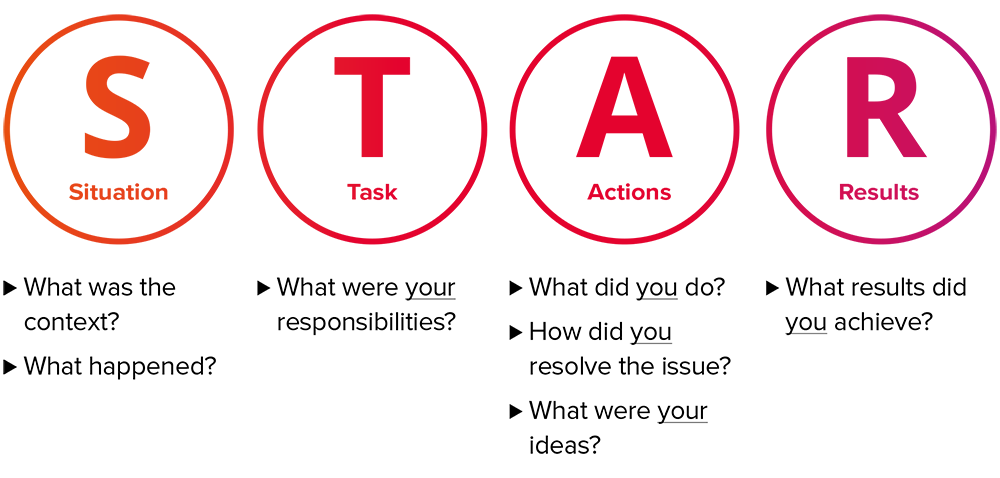
A great way to answer them clearly is using the STAR method.
Activity: The STAR method
Here's an example of the STAR method in practice.
If asked "Tell me about a time when you faced a challenge and how did you deal with it?" A strong response could be:
Situation: I was helping organise a sports day at the local school when several volunteers cancelled at the last minute.
Task: I needed to find enough people to cover all the planned activities.
Action: So I contacted additional volunteers, spoke to community members, and reorganised the teams so we could make the best use of the people available.
Result: The sports day went ahead successfully and all the planned activities were completed.
Now it's your turn...
Using the STAR method write down how you would answer the following interview questions:
| Question |
Situation |
Task |
Action |
Result |
| Give me an example of a time when you demonstrated leadership. |
|
|
|
|
| Tell me about a time when you had to manage your time effectively to meet a deadline. |
|
|
|
|
I think by the time you get to an interview stage, it's almost 100% attitude. You've got to show up. Are you someone who can sit and hold a conversation with someone across a desk? Because if you can't, then it's unlikely that you're going to be able to do it on the other end of a phone. We need people who show us they are hungry to grow and do well.
Dr Laura Dunstan-Smith, Managing Director, CoSauce
Introduction
1
2
3
4
5
6
7
Conclusion