A 'CV' means 'Curriculum Vitae' (Latin for 'course of your life') and is a summary of your education, experience, capabilities, achievements and interests. It is used as a document that introduces you to an employer.
It is very important in the application process as it helps determine whether you are worth interviewing.
Not every job application will require you to submit a CV, but many still do. For informal or temporary work, you will likely just be asked some questions in person, but for more formal jobs and with bigger companies, they are more likely to have a structured recruitment process.
If a company doesn't require a CV, often they will ask for the same content in a different format, such as in an application form, or possibly request your LinkedIn profile (an online professional networking site). That's why understanding the requirements of a CV and what employers are looking for is essential.
What to include
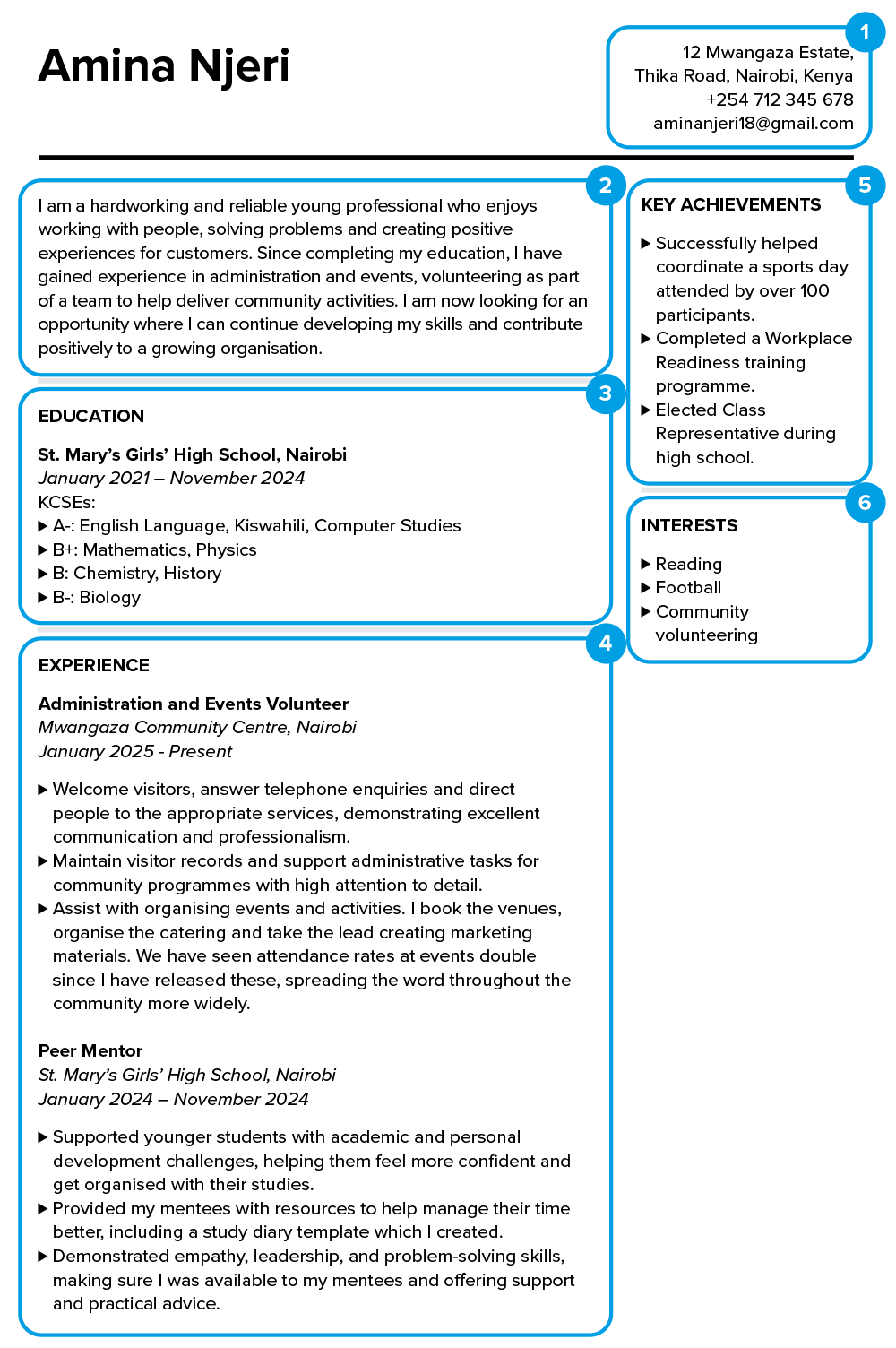
The below picture gives an example of a good CV, containing each of the following sections labelled with their corresponding number:
- Contact details: Where employers can reach you.
- Personal summary: A brief overview of who you are, your key strengths and what you are looking to achieve in a job.
- Education: Details of your academic background with grade and points score achieved.
- Experience: A summary of work, volunteering, or other relevant roles showing the key responsibilities you held, the skills developed and any results.
- Key achievements: Notable accomplishments that help you stand out like awards, projects, or competitions.
- Interests: Hobbies or activities that show your personality and passions.
Note: Depending on your age and experience 'Education' and 'Experience' can swap in order
- If you've just finished education or are still in education, then 'Education' typically goes first.
- If it's been a year or more since you left education, then 'Experience' should take priority.
Remember experience doesn't only come from formal employment. Types of experience could include:
- Paid work
- Running a small business or side hustle
- Volunteering
- Work experience or internships
- Leadership roles
- Community, faith or youth group involvement
- Helping with a family business
- Organising events or projects
5 top tips for a great CV
- Keep it to one A4 page: Even top CEOs can get their CV on one page; there's no reason you shouldn't either. It's not about how much you write, but about how clearly you can communicate your relevant achievements and skills.
- Give it a clear structure: Use headings to separate sections and use bullet points within sections rather than writing long paragraphs.
- Don't just list responsibilities: When presenting your experience make sure you include both the skills used and any results in each role – not just the responsibilities you had.
- Tailor your CV for every role you apply for: This doesn't mean starting from scratch every time, but reading the job description carefully, picking out key words, and editing your CV to highlight your most relevant skills and experience.
- Check your spelling and grammar: It's a quick and easy thing to check, but so often people miss this. Basic spelling and/or grammar mistakes can reflect poorly on your application.
In Section 2, you identified your strengths and the experiences that helped you develop them. Now it's time to turn those experiences into strong CV bullet points.
Imagine you are applying for your dream role. What strengths would help show an employer that you are a strong candidate?
Write down two strengths you are highlighting, and two bullet points that you could include in the Experience section of your CV to evidence these.
To help you:
- Start with an action word (e.g. organised, supported, led, assisted, created, coordinated)
- Describe what you did
- Highlight the skill you demonstrated or the impact you made
| Skill |
CV Sentence |
| Problem Solving |
Resolved customer concerns professionally and efficiently by listening carefully to their needs and finding solutions that worked for everyone. |
| |
|
| |
|
A one-page CV is probably going to go through some level of AI or automated analysis before a human looks at it. So keep it super, super simple because you want to get as much impact on that one page real estate as you possibly can. Your qualification, if you have one, is important, your experience is important, but don't go into long, lengthy, wordy paragraphs. Keep it to three short, sharp bullet points so that you are leaving yourself space to show all of your experience because that also matters.
Dr Laura Dunstan-Smith, Managing Director, CoSauce
Introduction
1
2
3
4
5
6
7
Conclusion